

 Facebook
 X
 Pinterest
 Copy Link
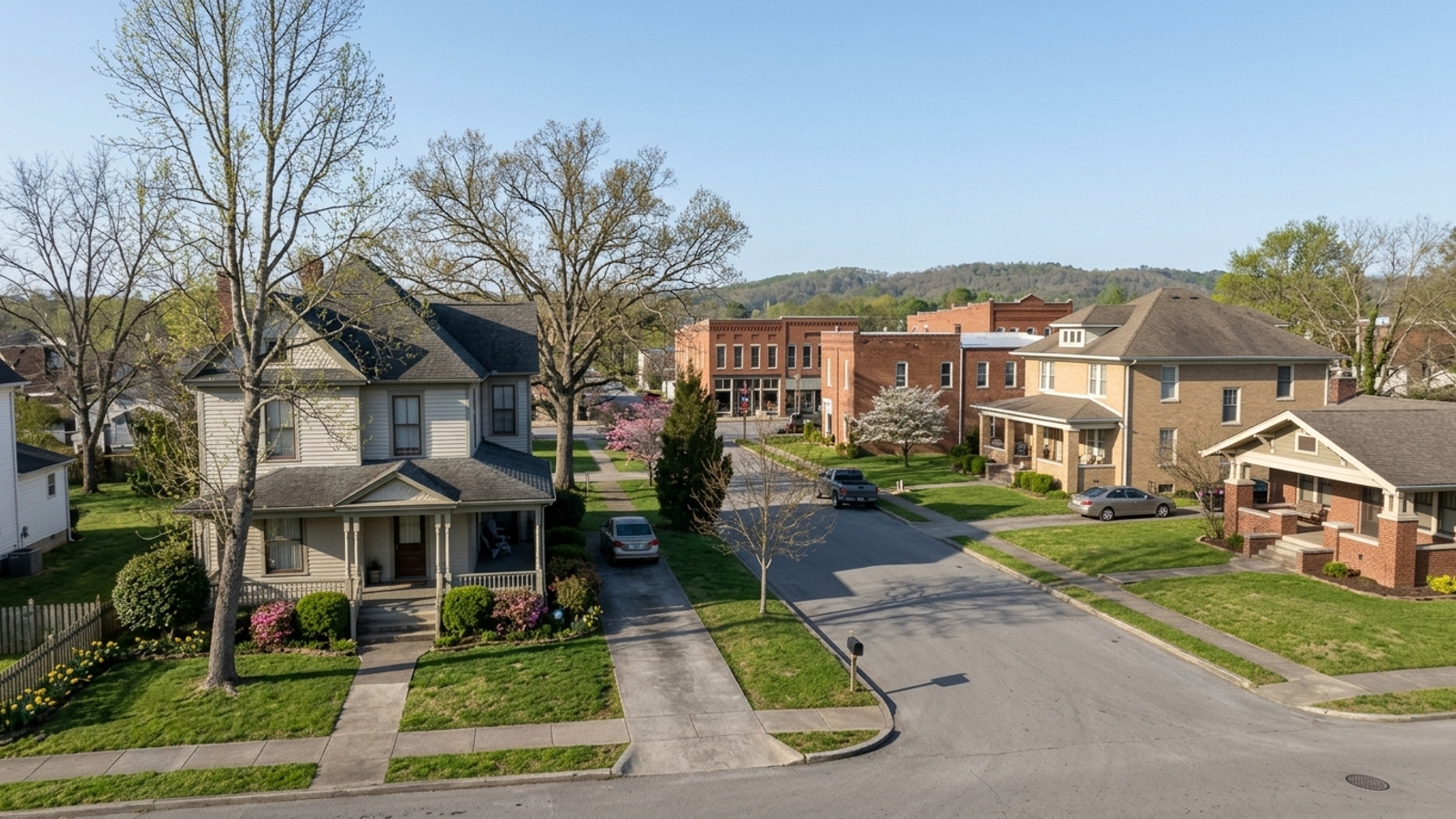
Morristown’s past as a Great Valley crossroads, a railroad junction, a county seat, and a TVA lake town still maps directly to its housing today. You’ll find an older core around the historic downtown, lake property on land reshaped by Cherokee Dam, and newer subdivisions along the highways.
With single-family prices down 9.6% year over year and homes taking a median 55 days to sell for the 90 days ending September 30, 2026, a buyer drawn to any of those eras currently has room to negotiate. For a closer look at day-to-day expenses, you can check out the guide to cost of living and day-to-day life in Morristown.
Key takeaway
To live inside Morristown’s history, start with the older homes around the historic downtown. If the TVA lake era is what draws you, look at Cherokee Lake instead. Either way, with 3.3 months of supply across all homes for the 90 days ending September 30, 2026, buyers currently have time to inspect properties and room to negotiate.
Who this guide is for
You’re curious about how Morristown came to be and are weighing whether its historic downtown, its lake, or its newer edges are where you’d want to buy.
Morristown history timeline
In the late 1700s, frontier settlement began along the Great Valley travel route. The area became a stopover point, eventually hosting a tavern run by the Crockett family. That early road network laid the groundwork for the downtown street grid you see today.
By 1858, the East Tennessee and Virginia Railroad completed its line from Knoxville to Bristol, passing right through town and ending the region’s isolation. The railroad era spurred early growth and left behind the oldest surviving homes near the tracks.
During the Civil War, the Battle of Morristown took place on October 28, 1864, when Union cavalry pushed back Confederate forces defending the area. Soon after the war, Hamblen County was formed in 1870, and Morristown became the county seat. That political shift concentrated government buildings and stately residential construction in the historic core.
The region changed dramatically when the Tennessee Valley Authority began construction on Cherokee Dam in August 1940. Completed on a crash schedule in December 1941 for wartime hydroelectric power, the dam created a massive reservoir that permanently turned the surrounding river valleys into a lakefront property market.
In the 1960s, local leaders launched an urban renewal plan to compete with rising suburban shopping trends. That effort produced the overhead sidewalks in 1967, an architectural feature that still defines the downtown block.
In the decades since, highway expansion and a growing manufacturing sector pushed development outward. That interstate era created the modern subdivisions that now ring the city’s edges.
Historic landmarks and museums in Morristown
Morristown preserves its past through several sites that reflect different eras of its development. These sites offer a firsthand look at how the city evolved from a frontier stopover to a mid-century commercial center.
Crockett Tavern Museum
The Crockett Tavern Museum connects Morristown to its frontier-road origins. The site honors the era when the Crockett family operated a tavern for travelers moving through the Great Valley, and it gives you a real sense of what the earliest settlement looked like before the railroad arrived.
Hours can be seasonal, so check the current schedule and event calendar before you make the drive.
Rose Center
Built in 1892 as Morristown’s first coeducational public high school, the building now known as Rose Center served as a school under various names until 1975. In 1976 it gained a second life as a cultural and arts facility. It’s a good example of how the county-seat era’s civic architecture was built to last.
Exhibits and events rotate constantly, so check the calendar before you visit to see what’s on display.
Downtown Morristown’s overhead sidewalks
Morristown built overhead sidewalks over its downtown streets in the 1960s, a design few American towns ever attempted. Most sources point to 1967 as the completion year for this SkyMart system. The town added these second-story walkways to address flooding and to compete with modern shopping malls.
Activity on the upper level varies by block. Walk the downtown overhead sidewalks and see which upper-level storefronts are currently open before you build a downtown-adjacent lifestyle around them.
Where Morristown’s history shows up in its homes
The city’s residential map is a direct reflection of its historical timeline, with distinct property types clustered by the era they were built. The three eras below correspond to three different property searches: older downtown homes, Cherokee Lake properties, and newer suburban subdivisions.
Older homes near downtown
The railroad and county-seat era left the oldest housing close to the historic core. This is the choice if you want to walk to the landmarks above and to the buildings where local history happened. The neighborhoods in Morristown guide covers which specific streets fit your search.
Older homes can carry dated wiring, plumbing, and foundations, and some properties may sit in a historic overlay with exterior rules. Get a full inspection on any older home, and ask the City of Morristown planning office whether a specific downtown-area property sits in a historic overlay or design district.
Homes on Cherokee Lake
Cherokee Lake is a TVA reservoir created by damming the Holston River in the 1940s. It didn’t exist before the dam. That wartime infrastructure decision is what created Morristown’s lake-house market, and if you want the TVA lake era as your backyard, this is where you look. Current prices are on the Cherokee Lake home prices page.
One thing buyers miss: TVA lowers the reservoir seasonally to manage flood storage and power demands. Winter drawdowns of up to 40 feet are common, so shoreline and dock access in winter can look very different from summer. View any Cherokee Lake property during TVA’s low-water season, confirm dock and shoreline permits directly with TVA, and check the TVA rules and waterfront buying guide for more details.
Newer subdivisions on the edges
The highway and manufacturing era pushed growth outward, which means newer systems and floor plans with downtown history a short drive away. The new construction guide covers builders and options, and the types of homes overview lets you compare layouts.
What you give up is historic character and walk-to-downtown access. Many newer communities also have homeowner associations, so ask any HOA for current dues and the covenants before you make an offer.
Morristown housing market today
The current market gives you room to negotiate. Single-family homes recently sold for 96.7% of their list price. On a home listed at $295,000, that ratio implies a sale around $285,000, roughly $10,000 under asking.
That said, well-kept older homes can still draw competition: 14.8% of single-family homes sold above list. For deeper trends, the Morristown housing market trends page is the right place to start, and the buyer closing costs and affordability guides will help you plan your budget. Katelyn Warren can help you run the numbers on specific properties.
How to decide where to look in Morristown
- Do you want to walk to the buildings this history was made in? Read the older homes section and the landmarks profiles, then check the neighborhoods guide.
- Is the water the part of Morristown’s story you want to live with? Read the Cherokee Lake section and the TVA rules on the waterfront page before falling for a dock.
- Would you rather have modern systems and a newer floor plan, with the history a short drive away? Go to the newer subdivisions section and the new construction guide.
- Are you deciding whether now is the time to make an offer? Review the housing market section for what current sale-to-list and above-list figures mean for your negotiation.
At a glance
- Median sale price, all homes: $292,361 (90 days ending Sept 30, 2026)
- Median sale price, single-family: $284,886 (90 days ending Sept 30, 2026)
- Year-over-year price change, all homes: -7.2% (90 days ending Sept 30, 2026)
- Year-over-year price change, single-family: -9.6% (90 days ending Sept 30, 2026)
- Median days on market, all homes and single-family: 55 days (90 days ending Sept 30, 2026)
- Sale-to-list ratio, all homes and single-family: 96.7% (90 days ending Sept 30, 2026)
- Share sold above list: 13.1% of all homes, 14.8% of single-family (90 days ending Sept 30, 2026)
- Months of supply: 3.3 for all homes, 3.5 for single-family (90 days ending Sept 30, 2026)
- Homes for sale (inventory): 109 all homes, 103 single-family (90 days ending Sept 30, 2026)
- Median price per square foot: $175 all homes, $182 single-family (90 days ending Sept 30, 2026)
- Homes sold: 101 all homes, 89 single-family (90 days ending Sept 30, 2026)
Morristown, TN history FAQs
What is Morristown, TN famous for?
Morristown is best known for its 1960s overhead sidewalks, the Crockett family tavern site, and Cherokee Lake. It’s also the Hamblen County seat, a role it has held since the county was formed in 1870.
What movies were filmed in Morristown, TN?
Research doesn’t confirm any major movies or horror films officially shot on location in Morristown. You can check with the Tennessee Entertainment Commission for verified filming locations across the broader region.
How did Morristown, TN get its name?
The town is named for Gideon Morris and his brothers Daniel and Absalom, who settled the area on North Carolina land grants around 1787. The name is entirely unrelated to Morristown, New Jersey.
What county is Morristown, TN in?
Morristown is located in Hamblen County and is the county seat. It’s the principal city of the Morristown Metropolitan Statistical Area, which encompasses all of Hamblen and Jefferson counties.
What was Morristown College?
Morristown College was a historically African American higher education institution founded in 1881 by the National Freedman’s Aid Society of the Methodist Episcopal denomination. The school closed in 1994, and its hilltop campus buildings were eventually demolished to create a city park that opened in 2019.
Is Morristown, TN in the mountains?
No. Morristown sits at an elevation of 1,302 feet in the Great Valley of East Tennessee, not in the mountains themselves. That valley location between the Great Smoky Mountains and Clinch Mountain made it a natural travel route throughout its history.
How far is Morristown, TN from Knoxville?
Morristown is approximately 41 miles from Knoxville, taking roughly 50 to 56 minutes via US-11E, I-81, and I-40. In the 1850s, the two cities were linked by the East Tennessee and Virginia Railroad.
What is the population of Morristown, TN?
Morristown had a population of 30,431 in the 2020 U.S. Census. The broader Morristown Metropolitan Statistical Area had 142,709 residents in that same census.
Sources
- Redfin: Data Center
- Tennessee Encyclopedia: Hamblen County
- Tennessee Encyclopedia: Railroads
- Tennessee Civil War Preservation Association: Battle of Morristown
- Tennessee Secretary of State: Hamblen County Facts
- Rose Center: Explore Our History
- Gresham Smith: Morristown SkyMart Lighting Upgrade
- TVA: Cherokee Dam
- TWRA: Cherokee Reservoir
- Historical Marker Database: Morristown College
- U.S. Census Bureau: Morristown, Tennessee
- National Map: Morristown
- Distance Cities: Morristown to Knoxville


